
Best overall: Shopify for a conventional online store. Best for WordPress businesses: WooCommerce. Best for structured catalog management: BigCommerce. Best for developer-led customization: Magento Open Source. This 2026 guide compares the platforms and explains what you must verify before launching an online store in Oman.
- Best ecommerce platforms Oman shortlist: Shopify, WooCommerce, BigCommerce, and Magento Open Source, each serving a different operating model.
- Shopify is the default recommendation for a standard store; verify Oman payment processing before committing.
- WooCommerce suits WordPress-led stores; Magento Open Source requires ongoing development and maintenance.
- Fizmoh offers web development and custom software services for businesses in Oman and the GCC.
Why this matters
Your ecommerce platform must support the way you collect payments, fulfill orders, and maintain stock. A strong storefront does not compensate for a payment provider that cannot onboard your business or an integration that creates duplicate orders.
For businesses needing implementation support, Fizmoh provides web development, custom software, and digital marketing services. Fizmoh is a service partner for Oman businesses that need ecommerce development, not an ecommerce platform. Keep that distinction clear when comparing platform subscriptions with development proposals.
The right 2026 decision starts with operating requirements. Choose the platform after identifying checkout, inventory, content, and reporting needs—not after selecting a theme.
What makes the best ecommerce platform for Oman?
Use these criteria to assess every shortlisted platform. A feature counts only when it works in your intended setup.
- Payment fit: Confirm that your chosen payment provider accepts your business, supports the platform integration, and handles your required transaction currency.
- Customer experience: Test mobile checkout, product selection, address entry, and any Arabic and English journeys you need.
- Operational fit: Establish how stock, refunds, shipping updates, and customer records move between systems.
- Search control: Check product URLs, redirects, indexing controls, structured data, and multilingual content handling.
- Maintenance ownership: Decide who handles updates, extension conflicts, backups, security checks, and incident response.
- Exit control: Review how you export products, customers, orders, images, and redirects before committing.
Do not treat these as equally important. Payment acceptance and order accuracy are launch requirements; advanced merchandising can wait until the underlying transaction works.
Ecommerce platforms at a glance
This ranking separates platforms by operating model rather than declaring every option suitable for every store. The limitation column deserves as much attention as the feature column.
| Rank and platform | Best for | Standout feature | Key limitation |
|---|---|---|---|
| 1. Shopify | Conventional stores prioritizing managed operations | Hosted storefront and commerce administration | Custom requirements depend on supported platform features and integrations |
| 2. WooCommerce | Businesses already using WordPress | Commerce within the WordPress environment | Hosting, updates, and extension maintenance remain your responsibility |
| 3. BigCommerce | Teams prioritizing structured catalog management | Hosted catalog and commerce administration | Specialized workflows still require integration checks |
| 4. Magento Open Source | Developer-led businesses needing deep customization | Code-level control over commerce behavior | Requires substantial technical ownership |
These are platform recommendations, not confirmations of Oman payment-provider eligibility. Obtain written confirmation of your specific integration before signing off on a build.
1. Shopify: best ecommerce platform for standard online stores
Shopify combines a hosted storefront with tools for managing products, orders, and customers. You operate the store within its platform rather than maintaining the underlying application hosting yourself.
Best for: A business launching a conventional product catalog without a requirement to control the commerce application's underlying code.
Shopify earns the default position because it separates routine store administration from server administration. That is a useful starting point when your team wants to manage products and orders rather than maintain application infrastructure.
Shopify pros
- Hosted infrastructure removes a separate application-hosting task from your team.
- Products, orders, and customer records sit within the commerce administration interface.
- Themes and apps provide established routes for extending storefront functionality.
- A managed platform gives nontechnical staff a defined environment for daily store work.
Shopify cons
- Unusual checkout or operational requirements must fit supported platform capabilities.
- Apps introduce additional dependencies that need review and maintenance oversight.
- An available payment integration does not establish that your Oman business qualifies for an account.
Before choosing Shopify in 2026, demonstrate your hardest requirement first. If that requirement is a particular payment flow or an ERP connection, test it before approving storefront design.
Verdict: Buy Shopify for a conventional store after confirming payment and integration fit.
2. WooCommerce: best ecommerce platform for WordPress businesses
WooCommerce adds ecommerce functionality to WordPress. It suits businesses that want editorial content and online selling within the same website environment.
Best for: A company with an established WordPress website, substantial content requirements, or a development partner responsible for ongoing maintenance.
WooCommerce is a strong choice when commerce must work closely with your existing content structure. Its flexibility also creates responsibility: someone must own hosting quality, extension selection, updates, and recovery procedures.
WooCommerce pros
- Products and editorial content can share the WordPress environment.
- Developers can customize store behavior through code and extensions.
- Hosting selection remains under your control.
- Existing WordPress publishing workflows can support product education and buying guides.
WooCommerce cons
- Updates across WordPress, themes, and extensions require compatibility checks.
- Store performance depends on implementation, hosting, and extension choices.
- Custom integrations need a named owner when something breaks.
Do not choose WooCommerce solely because your team recognizes WordPress. Ask who will maintain the complete store after launch, including checkout extensions and background integrations.
For an Oman business, demonstrate the actual payment extension and settlement workflow—not an unrelated installation using a different provider. Familiar software does not remove merchant onboarding requirements.
Verdict: Buy WooCommerce when WordPress is central to your website and maintenance ownership is clear.
3. BigCommerce: best ecommerce platform for catalog-led teams
BigCommerce is a hosted ecommerce platform with tools for managing products, storefronts, and orders. It belongs on the shortlist when catalog administration is central to your buying decision.
Best for: A team evaluating hosted commerce around product organization, catalog workflows, and connections to existing business systems.
Use your own catalog to evaluate BigCommerce. Product options, categories, images, identifiers, and stock rules reveal more than a demonstration populated with sample products.
BigCommerce pros
- Hosted infrastructure separates store management from application-server maintenance.
- Catalog and order tools provide a central commerce administration environment.
- APIs support connections to external systems.
- Storefront implementation can be assessed separately from back-office data requirements.
BigCommerce cons
- Specialized business rules still require technical validation.
- API availability alone does not guarantee a working integration with your existing software.
- Payment-provider eligibility must be confirmed for your business and intended setup.
For a 2026 evaluation, import a representative catalog sample rather than assessing appearance alone. Include products with different options, incomplete stock, and images that need consistent handling.
Choose BigCommerce when that demonstration shows a better fit for your catalog workflow—not because a feature checklist contains more entries. A feature that staff cannot use correctly adds little operational value.
Verdict: Buy BigCommerce when its catalog workflow fits your team and required integrations pass testing.
4. Magento Open Source: best for developer-led customization
Magento Open Source is a self-managed ecommerce application that developers can modify at code level. It provides a different ownership model from a hosted commerce service.
Best for: A business with documented custom requirements and a technical team responsible for development, hosting, security, and maintenance.
Magento Open Source belongs here when standard platform behavior is a genuine constraint. It is not the default recommendation for a straightforward store whose requirements fit a managed platform.
Magento Open Source pros
- Code-level access supports changes to application behavior.
- Hosting and deployment architecture remain under your control.
- Developers can build integrations around documented operational requirements.
- Custom workflows do not need to be limited to theme-level changes.
Magento Open Source cons
- Your team owns application maintenance and infrastructure decisions.
- Security updates and extensions require an ongoing technical process.
- Custom code increases the work involved in testing future changes.
Do not confuse control with simplicity. Every departure from standard behavior needs documentation, testing, and someone accountable for supporting it.
Require a clear explanation of why Shopify, WooCommerce, or BigCommerce cannot meet your essential requirements before choosing this route. A preference for customization is not itself a business requirement.
Verdict: Hold Magento Open Source until custom requirements justify permanent technical ownership.
Check the Oman operating requirements before signing
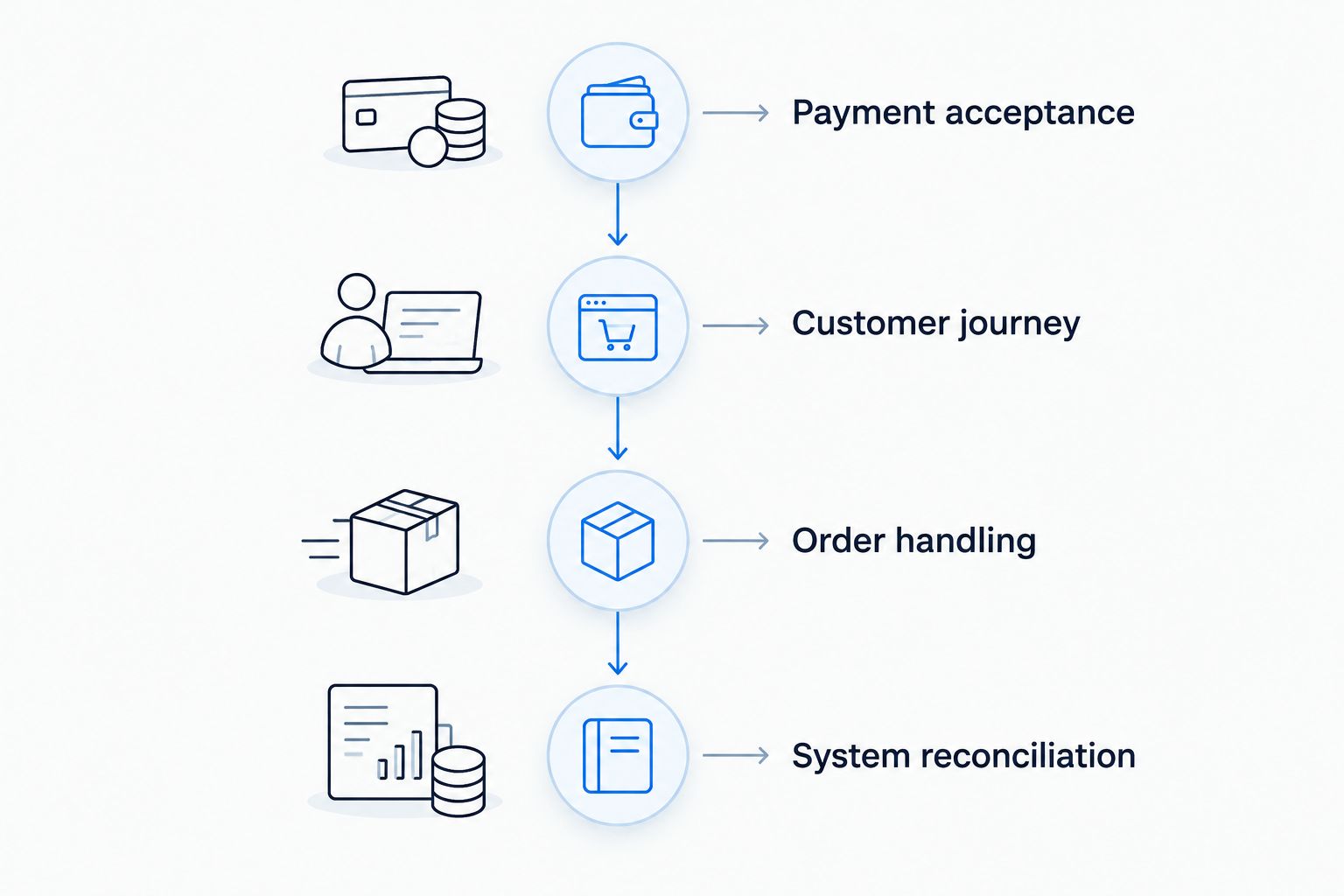
A platform demonstration should follow your transaction from checkout to reporting. For a 2026 launch, ask the implementer to show the following sequence using your intended systems.
Payment acceptance
Confirm merchant eligibility directly with the payment provider. Then test authorization, unsuccessful payments, cancellations, and refunds through the proposed integration.
A gateway name on a platform's integration list is not proof that your business can use it. Separate technical compatibility from merchant approval.
Customer journey
If you need Arabic and English, review 2 language journeys from product discovery through order confirmation. Check navigation, product options, address fields, validation messages, and transactional communication.
Language support is a complete buying journey, not a translated homepage. Assign ownership for keeping product information consistent across languages.
Order handling
Run 4 test orders: a successful payment, a declined payment, a refunded order, and an order containing unavailable stock. These are recommended acceptance tests, not platform performance benchmarks.
Record what staff must do manually in each case. Manual work is acceptable when intentional; undocumented workarounds create uncertainty.
System reconciliation
Compare 3 operational records: the storefront order, the payment record, and the accounting entry. Product identifiers, amounts, and order statuses should reconcile according to your documented process.
If you also sell in person, review the relationship between your storefront and POS systems for retail stores in Oman. Establish which system owns stock before connecting them.
How this ranking works
The ranking prioritizes operational fit, maintenance ownership, and the ability to demonstrate essential requirements. Shopify is the default for conventional stores; WooCommerce leads when WordPress is central; BigCommerce serves catalog-led evaluations; Magento Open Source serves justified code-level customization.
This is a requirements-based shortlist, not a claim of hands-on benchmarking or verified local payment compatibility. Use the criteria above to challenge each recommendation against your business.
For ecommerce implementation, Fizmoh offers web development and custom software services. Ask any development partner to separate platform configuration, custom development, third-party dependencies, and ongoing maintenance in the project scope.
Which ecommerce platform should you choose?
Choose Shopify unless a documented requirement points elsewhere. Move to WooCommerce when WordPress integration and implementation control matter more than managed application hosting.
Evaluate BigCommerce when catalog administration drives the decision. Consider Magento Open Source only when code-level requirements justify a dedicated technical operating model.
For your 2026 project, write the acceptance checklist before requesting proposals. It gives every supplier the same target and makes differences between proposals easier to assess.
FAQ
What's the best ecommerce platform for a new online store in Oman?
Shopify is the default recommendation for a conventional new online store in Oman. Confirm your payment-provider eligibility and essential integrations before committing.
Is WooCommerce better than Shopify for an Oman business?
WooCommerce is the stronger fit when WordPress is central to your website and you have maintenance support. Shopify is the stronger default when you want hosted commerce without managing the underlying application hosting.
Can an Oman business use any payment gateway listed by a platform?
No. A listed integration establishes a technical connection, not merchant eligibility. Confirm onboarding, transaction currency, refunds, and settlement requirements directly with the provider.
Do I need an Arabic ecommerce website in Oman?
Base Arabic support on the customers you intend to serve. If Arabic is part of your requirements, test the complete buying journey rather than translating only navigation and landing pages.
When should I choose Magento Open Source?
Choose Magento Open Source when documented requirements need code-level customization and a technical team will maintain the application. A straightforward store does not justify that operating model by itself.
Can I connect an online store to my POS or accounting software?
Connections depend on the specific systems, available interfaces, and implementation. Demonstrate stock updates, refunds, and accounting records using your intended setup before approving the integration.
Is Fizmoh an ecommerce platform?
Fizmoh is a Muscat-based digital agency, not an ecommerce platform. Its services include web development, custom software, digital marketing, and SEO for businesses across Oman and the GCC.
One last thing
Test a failed payment before celebrating a successful sale. The failure path reveals whether customers receive clear instructions, stock stays accurate, and staff can identify what happened.
Put that test in your acceptance checklist. A store is ready when the exceptions work—not only when the homepage looks finished.